Browser / Daily word puzzle / Game guide
Middle Word (PZL): read the alphabet clues and play the daily puzzle
Play the original PZL puzzle here, learn what its dictionary-distance clues mean, and practise narrowing two word boundaries without a daily-answer spoiler.
Play on this page ↓Open original game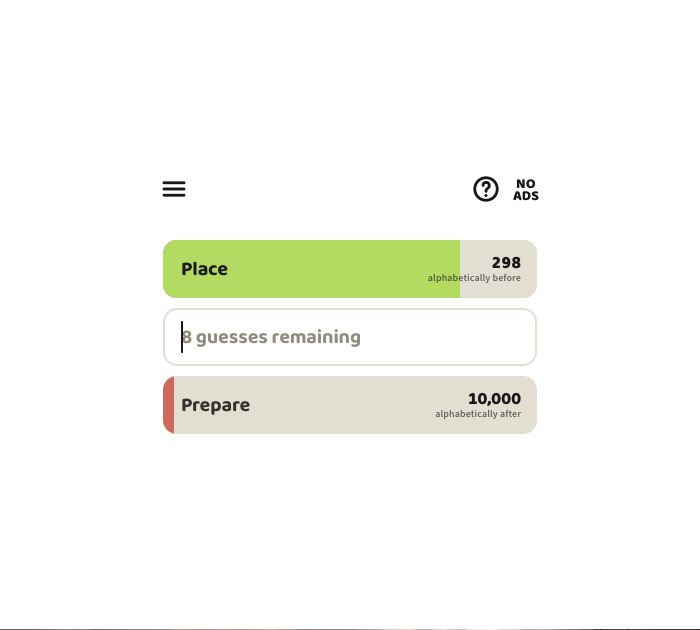
A little puzzle break
Play Middle Word
The original game by PZL games, right here on Play739.
Find your place in the alphabet.
Ten guesses, two boundaries and a word to discover. Start the original game when you are ready.
The game loads from PZL games only after you press Play. Its own privacy terms and browser progress apply.
From our playtest
On October 29 we entered valid guesses on the original website and completed one daily round inside a local Play739 iframe. We then opened the October 28 archive puzzle, entered another valid guess at a 360px browser width and reloaded the frame with that progress retained. This covers desktop keyboard play and a narrow browser layout; it is not a physical-phone or touch-keyboard test, a review of every archived puzzle, or an answer service.
Tested . The game is developed independently; this guide describes the version we checked.
Start with the PZL version
The player above opens Middle Word from PZL games, published by Perfect Level Games Ltd. Press Play to load it, then click the word box and submit a guess with Enter. We played without creating an account. If your browser blocks or stalls the frame, use Open original game to continue on the publisher’s site.
The game presents an earlier word and a later word, with the answer somewhere between them in dictionary order. It gives you ten guesses. The task is about spelling order, so two words do not need related meanings to be useful neighbours.
Treat every clue as a boundary
Read the direction and the number together. A word marked before belongs earlier in the dictionary than the target; an after clue belongs later. Keep your attention on the closest useful word on each side rather than repeatedly working from the large opening interval.
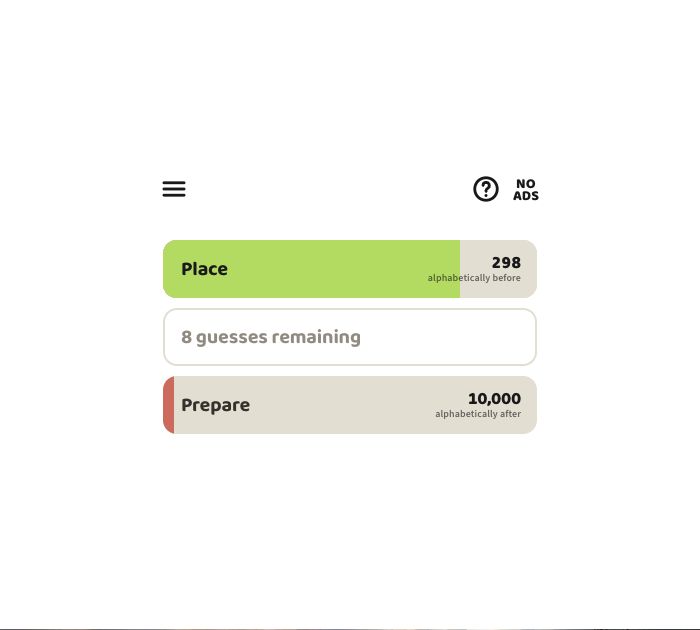
For example, our October 29 check returned a distance of 5,918 for one accepted guess and 298 for a later accepted guess, both before the target. That second result moved the useful lower boundary much nearer. Those figures count dictionary entries, not letters, points, seconds or a measure of how similar the meanings are. They illustrate one recorded puzzle, not a reusable daily answer.
| What you see | How to use it |
|---|---|
| Before | Look later in alphabetical order than this guess. |
| After | Look earlier in alphabetical order than this guess. |
| A smaller dictionary distance | Keep this closer clue in view when choosing the next candidate. |
| Guesses remaining | Check this after feedback settles before spending another attempt. |
Compare spelling one position at a time
When two words share their first letters, move to the first position where the spelling differs. A guess with the right opening letter can still be far outside the useful pocket. Write the two current boundaries down if you keep losing your place as the board changes.
A short word can also sort before a longer word that starts with the entire short word. Think about ordinary dictionary ordering instead of trying to average the lengths of the two clues. The alphabetical midpoint is not necessarily halfway through the alphabet or halfway between the two word lengths.
Worked example: check a word before spending a guess
Suppose your closest lower boundary is place and your upper boundary is prepare. Compare a candidate with both words from left to right, stopping at the first different letter. The following is a spelling exercise written for this guide, not a puzzle answer or a claim that these candidates are accepted by the game.
For plane, p and l match place, then a matches a, and n comes after c: plane is later than place. Against prepare, the second letter l comes before r, so plane is earlier. It fits the interval. That makes it eligible for consideration; it does not make it the answer or the exact middle of the game’s dictionary.
| Candidate | Compared with place … prepare | Decision |
|---|---|---|
| pine | i comes before l in the second position | Below the lower boundary; discard it. |
| plane | Later than place and earlier than prepare | Inside the spelling interval; assess it against the remaining clues. |
| present | Against prepare, s comes after p at the fourth letter | Above the upper boundary; discard it. |
Change pace as the interval shrinks
At the start, choose a familiar word that seems to divide the remaining spelling range usefully. Then read the returned distance before planning the next move. If a large part of the range is still unexplored, changing the opening syllable can be more informative than making tiny variations of the same word.
Once the two useful clues are close, switch to a small mental list of everyday candidates that actually fit between them. The publisher describes the target as a common word in its dictionary form. A rare inflection or an elaborate proper name is therefore a poor default when a plain word fits the evidence. This is a way to organise guesses, not a guarantee that a particular opening wins.
Use a smaller distance without losing the other boundary
Our recorded before-target distance improved from 5,918 to 298. That tells us the lower wall moved closer. It does not identify the upper wall: keep the closest after-target clue as well, even if it came from an earlier turn. A new clue on one side does not erase the information on the other.
Before submitting again, check three things: the candidate sorts strictly between your best two boundaries, it is a common dictionary-form word, and the choice is justified by the current interval rather than the meaning of an earlier guess. After submitting, wait for a feedback row and update only the relevant boundary. If no row appears, check the input and any validation message before assuming the word spent a guess.
Use the archive for a different round
After our completed daily round, the original game offered a Middle Word archive. We opened it and selected Day 28 to load a separate puzzle, with a new pair of starting words and ten available guesses. A valid entry then produced fresh directional feedback. This is the route we verified for another round; reloading the iframe is not a reset button for the day you already played.
In this local check, reloading kept the selected archive puzzle and its accepted guess. The publisher also says browser storage holds anonymous progress. Keep in mind that an embedded view and a separate original-site tab may have different storage behaviour, and clearing site data can remove saved progress. We did not test account sync or the whole archive.
Keep each guess tied to the board
Click the word box before typing, especially after using a page control outside the game. A new feedback row is your confirmation that a word was accepted. Read its direction, distance and the remaining-guess counter before choosing another word. If keyboard input is not reaching the embedded game, the original-site link gives you a separate view to try.
Use your current puzzle’s words when following the examples. The screenshots record an earlier board and stop before its solution, so their numbers explain the clue system rather than prescribe an opening sequence for every day. After a round, use the archive to practise the same process with another pair of boundaries.
In the game
Sources & update record
- PZL games — original Middle Word
- PZL games — how to play Middle Word
- PZL games — privacy and terms, including browser progress
- PZL games — publisher information
October 29, 2026 — Playtest observations and creator information checked for this guide. Game names belong to their respective owners.
Another game, another little discovery.
Feetle word game: how the daily ladder works
Change one letter at a time to reach FEET, with a small example that explains a legal move.
Read the guide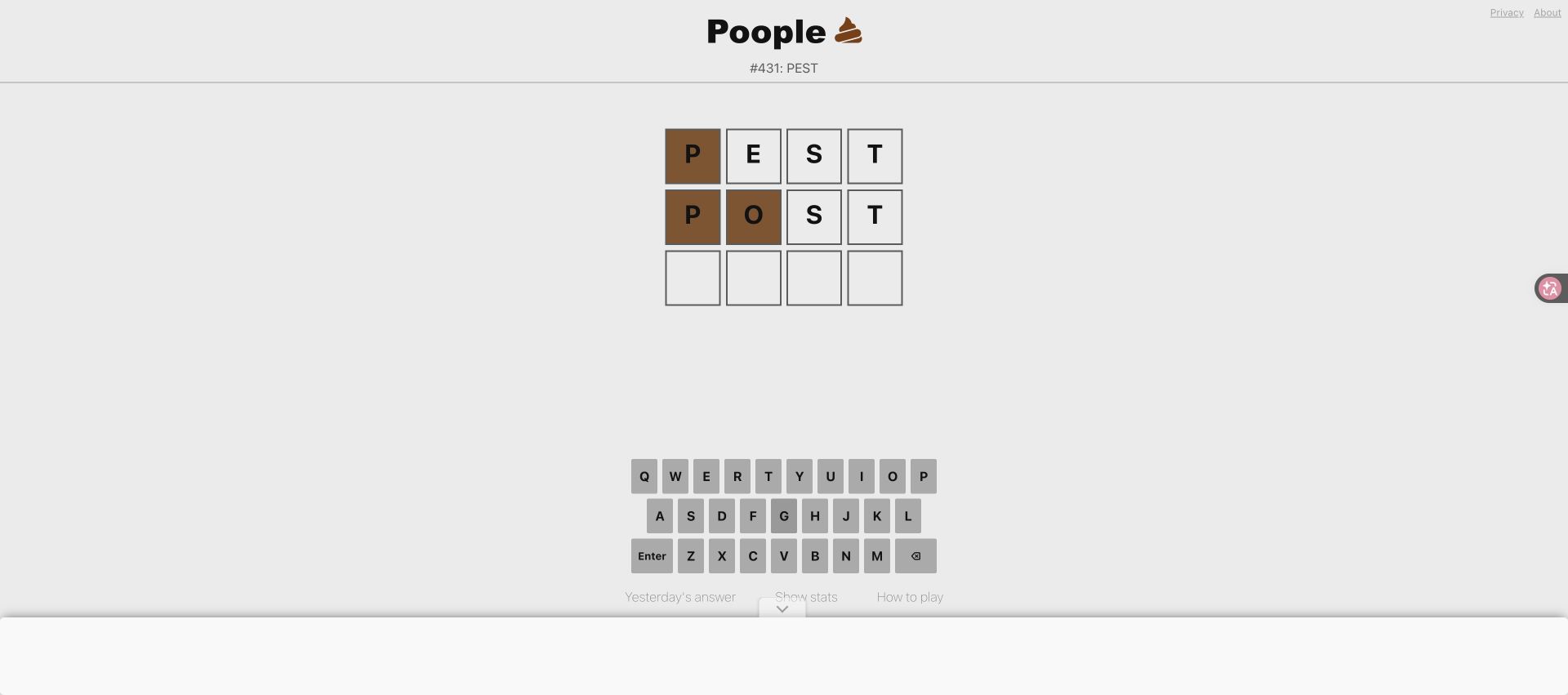
Poople word game: one-letter moves on the way to POOP
Learn the four-letter ladder rule and use a checked PEST-to-POST example without mistaking it for a complete solution.
Read the guide
Mosaicle rules: reading clues, empty squares and daily pictures
Learn the nonogram rule with a small worked example, then choose daily or practice play in Majkel Studio’s browser demo.
Read the guide